Writing Has Never Been About the Hand That Holds the Pen

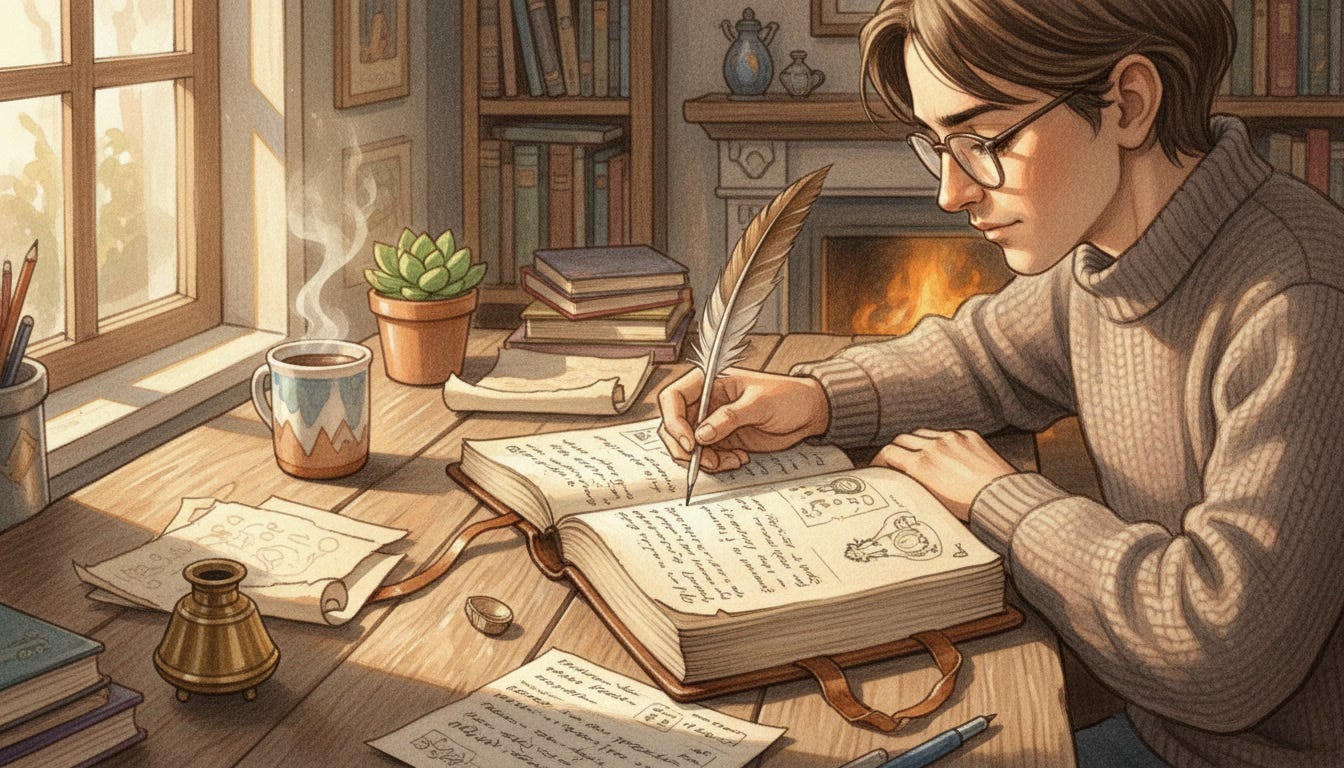
I’ve been told I’m not a real writer because I use AI to help craft prose from my handwritten chapter synopses. That I’m a “prompter,” a “creation analyst,” or at best a “co-author with AI.”
Here’s what nobody told me until I started digging into the history: John Milton was blind when he dictated Paradise Lost. Henry James paced rooms speaking his masterpieces to hired typists. Barbara Cartland wrote 723 novels without ever touching a pen.
If physical transcription defines authorship, like sitting in a chair at a desk and physically writing, then literature’s canon needs to be reattributed to anonymous daughters, secretaries, and stenographers.
It doesn’t. Because writing has never been about the hand that holds the pen. It’s about the mind that shapes the story.
Let me show you the receipts.
Writing began as accounting, not art
Cuneiform—humanity’s oldest writing system—emerged around 3400 BCE in Mesopotamia. Not to capture poetry. Not to preserve epic tales. To track surplus grain and business transactions.
The earliest “writers” were scribes: elite professionals who served temples, royalty, and military authorities. They performed what we’d now call accounting, notary work, and governmental functions. They weren’t considered creative figures. Writing was about power and administration.
The physical medium shaped everything. Clay tablets required pressing wedge-shaped reeds into wet earth—durable but clunky. Papyrus enabled scrolls up to 133 feet long. Parchment introduced the revolutionary possibility of writing on both sides and folding pages into books. Paper arrived in Europe in the 12th century.
Each transition changed not just what writing looked like, but who could write and how they wrote.
Then came the technology that changed everything.
The printing press was accused of witchcraft
In 1474, Genoese scribes petitioned to outlaw Gutenberg’s press, arguing that because it employed “uneducated people,” the technology “had no place in society.”
Two years later, Parisian scribes attacked and destroyed Johann Heynlin’s press, fearing it “endangered their livelihood and status.”
When Johann Fust sold printed Bibles in Paris, scribes accused him of witchcraft. The pages were “so perfectly consistent, so gorgeously precise that no mortal hand could have possibly produced them.”
The 15th-century abbot Johannes Trithemius called the press “a whore” and printers “asses,” petitioning the Doge to ban the technology entirely. He feared books would be “debased” by accessibility to “every Tom, Dick and Harry.”
Sound familiar?
Four centuries later, the typewriter generated identical anxieties. Mark Twain—among the first American authors to adopt the technology—called it “full of caprices, full of defects—devilish ones.” He begged Remington not to associate his name with the machine: “Please do not even divulge the fact that I own a machine.”
Yet Twain became the first author to submit a literary typescript to a publisher.
The word processor arrived in the 1970s-80s accompanied by Gore Vidal’s declaration: “The word processor is erasing literature.”
At Johns Hopkins’ MFA program, applications typed on word processors were viewed with suspicion. At Iowa Writers’ Workshop in the 1980s, authors doctored their computer printouts, adding pencil annotations to make manuscripts seem more “real”—to hide the shameful fact of technological assistance.
The pattern repeats: resistance, gradual normalization, eventual invisibility of the once-controversial tool.
Etymology reveals the truth: “Writer” means “one who scratches,” “Author” means “one who creates”
The word “writer” derives from Old English wrītere—”draughtsman, painter, writer, scribe, copyist.” The Proto-Germanic root writan meant simply “tear, scratch.” Across Indo-European languages, words for “write” originally meant carve, scratch, cut. The word describes a physical act, mechanical and replicable.
“Author” traces a completely different lineage.
From Latin auctor—”promoter, producer, father, progenitor; builder, founder”—it etymologically means “one who causes to grow.” Where “writer” points to the hand, “author” points to the creative source.
Medieval scholars recognized four types of book-makers:
Scriptor (copyist): writes others’ words without addition
Compilator (arranger): combines others’ work without original contribution
Commentator (interpreter): adds interpretation to existing texts
Auctor (originator): writes primarily his own words, using others only for support
To be an auctor was not merely to write but to possess authority, trustworthiness, cultural weight. The Statute of Anne in 1710—the world’s first copyright law—transformed this into legal property, formally recognizing authors as the primary beneficiaries of their creative work.
The distinction matters: writing is the mechanical act. Authorship is the creative origin.
Dictation reveals where authorship actually resides
If physical inscription defined authorship, we’d need to revise literary history.
John Milton went blind at age 43. He dictated Paradise Lost to his daughters and paid assistants by memorizing 20-line segments each night and reciting them each morning. Paradise Lost has been called “in the most literal sense a truly oral epic.”
Nobody questions Milton’s authorship.
Henry James developed wrist problems in his 50s and turned to dictation, speaking his later masterpieces—The Ambassadors, The Wings of the Dove, The Golden Bowl—to typists like Theodora Bosanquet. James would pace in silence, thinking through characters and scenarios, then begin speaking without warning.
“It all seems to be so much more effectively and unceasingly pulled out of me in speech than in writing,” James explained.
The creative work happened in his prefiguring imagination. Bosanquet merely recorded.
Fyodor Dostoevsky dictated to stenographer Anna Grigoryevna Snitkina under crushing deadline pressure—completing The Gambler in 26 days to avoid forfeiting all future copyrights. Anna recorded in shorthand by day and transcribed by night. She later served as stenographer for The Idiot, Demons, and The Brothers Karamazov.
Barbara Cartland wrote 723 novels—over a billion copies sold—by dictating up to 8,000 words daily while reclining on a pink couch. She never physically wrote any of them.
Winston Churchill dictated A History of the English Speaking People. Sidney Sheldon dictated all 18 of his bestselling novels.
None of these works are attributed to their transcribers. The creative act—the authorship—resided entirely in the composing mind.
Editors and ghostwriters prove collaboration doesn’t eliminate authorship
Maxwell Perkins, working at Scribner’s from 1910-1947, shaped the works of F. Scott Fitzgerald, Ernest Hemingway, and Thomas Wolfe so substantially that 68 books were dedicated to him at his death—more than any other editor in history.
Perkins cut approximately 90,000 words from Wolfe’s first novel Look Homeward, Angel and changed its title from “O Lost.” He battled Wolfe for two years over Of Time and the River. Critic Bernard DeVoto accused Wolfe’s manuscripts of being “hacked and shaped and compressed into something resembling a novel by Mr. Perkins.”
Yet no serious argument exists that Perkins—rather than Wolfe—authored these works. The creative vision, the characters, the plots, the language all originated with Wolfe. Perkins shaped but did not create.
Ghostwriting extends this logic further.
Conservative estimates suggest 80% or more of celebrity memoirs are ghostwritten. Nonfiction bestsellers: at least 60% ghostwritten. The ghostwriting market reached $4.27 billion in 2025.
Yet ghostwriters explicitly disclaim authorship. As ghostwriter Kevin Anderson explains: “A ghostwriter is an interpreter and a translator, not an author, which is why our clients deserve full credit for authoring their books.”
Political speechwriting operates by similar norms—but with complete invisibility. Ted Sorensen likely wrote JFK’s “Ask not what your country can do for you” line. FDR would rewrite speeches in his own handwriting to hide that Raymond Moley had drafted them.
The creative architecture belonged to the president. The words themselves were negotiable.
Philosophy confirms: authorship is a function of meaning, not mechanics
Roland Barthes argued in “The Death of the Author” (1967) that the text is a “tissue of quotations drawn from innumerable centers of culture.” The author doesn’t precede the text as some originating genius—they’re born simultaneously with it.
Paradoxically, Barthes’ radical decentering of authorship supports the argument that physical transcription is irrelevant. If the author is merely a medium through which language speaks, then the hand moving the pen matters even less than the selecting consciousness.
Michel Foucault’s “What Is an Author?” introduced the “author function”—a discursive construct serving to limit and organize meaning within culture. The physical writer and the constructed author are different things.
The architectural analogy proves illuminating: Architects design buildings but do not physically construct them. No one questions that Frank Lloyd Wright “built” Fallingwater—the creative work was the design, not the labor of pouring concrete.
Composers create music but may never perform it. Beethoven composed his late masterpieces while deaf.
The creative act is composition, not execution.
Writers operate by identical logic.
My process fits a centuries-old tradition
I write detailed chapter synopses by hand. I include story beats, settings, sensory details, character actions and personalities, dialogue, everything that makes the story mine.
Then I use AI to help craft the prose in my style—based on 20,000 words I typed myself during a week-long vacation from a job that at the time took a lot of hours from me.
That’s my process. It’s collaborative. It’s iterative. It’s intensive. By all intents is also slow. You’d think that I would be cranking out stories but that’s simply not the case.
And it’s fundamentally the same as Milton dictating to his daughters, James pacing while Theodora Bosanquet typed, Dostoevsky speaking to Anna while she transcribed in shorthand.
The creative work—the authorship—is in the composing mind. The tool that executes that vision has always been secondary.
When people tell me I’m not a real writer, they’re making the same argument 15th-century scribes made about the printing press. The same argument traditionalists made about typewriters. The same argument that dismissed word processors as “erasing literature.”
They’re wrong for the same reason those arguments were always wrong: they confuse the mechanism with the creation.
No amount of proof will ever be enough for some people
After publishing my first article defending AI-assisted writing, a reader commented. She looked at the photos of my handwritten journals and concluded they were “just notes”—not a complete novel.
I explained: I wrote the entire novel by hand. Nearly 200 pages past chapter 11 alone. I offered to send more photos, more proof.
Her response: “I’m deeply uninterested in any proof from you one way or the other.”
There it is. The mask comes off.
She demanded to know what I actually did. I explained. She said it wasn’t enough. I offered proof. Now she’s “deeply uninterested” in proof.
Her final argument: “Either you wrote the novel yourself, or not. If you did, you’re a novelist. If you didn’t, you’re not a novelist.”
A perfect false binary. It ignores that Milton dictated. That James spoke his novels to typists. That Cartland never touched a pen. That ghostwriters exist. That collaboration has always been part of writing.
By her logic, if you use dictation software that transcribes your spoken words, “the AI completed it” and you’re not a novelist.
She’s not interested in understanding the process. She’s interested in protecting a predetermined conclusion: I don’t count.
You can’t reason someone out of a position they didn’t reason themselves into.
The AI debate is not new—it’s the same pattern playing out again
Every argument about AI and writing echoes previous technological controversies.
The scribes’ complaint that printing employed “uneducated people” mirrors concerns that AI lacks genuine understanding. The Iowa workshop’s penciled annotations to hide word-processor use parallel contemporary anxiety about disclosing AI assistance. The claim that AI-generated text “is not your authorship” resembles telling Henry James’s secretary she should be “part of the machinery.”
Are there legitimate questions about AI, disclosure, and creative authenticity? Yes. Absolutely.
But the framework for those discussions should start from historical reality: writing has never been reducible to the physical act of putting words on a surface. The creative work—the authorship—resides in what gets written, not how it gets recorded.
The selecting, arranging, revising, deciding consciousness is the author. The mechanism of transcription is the tool.
Nothing new under the sun
The 15th-century scribes were wrong that printing would destroy literature. Mark Twain was wrong that the typewriter was devilish. Gore Vidal was wrong that word processors would erase literature.
Each technology changed writing—sometimes profoundly—without eliminating the essential human act at its core: the creative mind making meaning through language.
The question was never about the tool.
It was always about the author wielding it.
I spent twenty years with stories locked in my head because I thought I had to suffer through the tedious parts to be a “real” writer. AI gave me a process that works with my life instead of against it.
I write the stories. I make the creative decisions. I shape every scene. AI helps me execute that vision—the same way Milton’s daughters helped him, the same way Theodora Bosanquet helped Henry James, the same way Anna Grigoryevna helped Dostoevsky.
The gatekeepers can call me whatever they want. “Prompter.” “Creation analyst.” “Not a real writer.”
History proves them wrong.
I’m an author. My stories exist because of my creative intent, my vision, my decision-making. The tool I use to execute that vision doesn’t change what I am.
It never has.
But I want you to be the judge. Check out the story and give it a chance. If your interested you can buy My first full length novel, Forbidden Bond here.
https://www.amazon.com/dp/B0FLB54TZV
Or you can read it on Royal Road for free: https://www.royalroad.com/fiction/89008/forbidden-bond-a-velthorn-tale/chapter/1689561/prologue
Or if you don’t want to go that far then you can check out a new story that I have started here called The Chronicles of Esbeth. It is based upon Daily writing prompts from my wordpress account. I use Claude to aid me into turning them into full length stories. Anyhow. Thanks for reading the article and thank you to all of the people that have followed me. I sincerely appreciate it. I will be trying to get an article out at least once a week.
Chad Rye is the author of two fantasy novels, Forbidden Bond and The Broken Shield and runs a daily fantasy short story blog at chadwickrye.com. He operates C&K Laser Engraving with his wife and lives in Madison, Florida.
I get what you’re saying but there is one difference between what you’re doing and what those older authors were doing. They may have been dictating but they were still creating the actual prose of the novel which is the defining feature of the novel that sets it apart from a screenplay or any other form of art. When you use AI to write your prose based on that one 20,000 word novella, it’s very different. It’s like if those authors you mentioned had given their scribes an outline and then told them to write the novel and make stylistic choices based on a single piece of work that author had written months or years ago. I’m also curious as to how you would be able to progress with your stylistic ability if all your stuff is based on the prose of an old piece of work. This isn’t a hate comment. Just giving a different perspective. If what you’re doing works for you, keep going. No one can stop you.
I don’t use Ai but if I find something interesting I don’t really care who or what wrote it. At least you actually write and just use AI to optimize your workflow.