The Silver Wolf Who Saved Me: Chapter 2: The Quiet Between Storms
Chronicle Entry Two

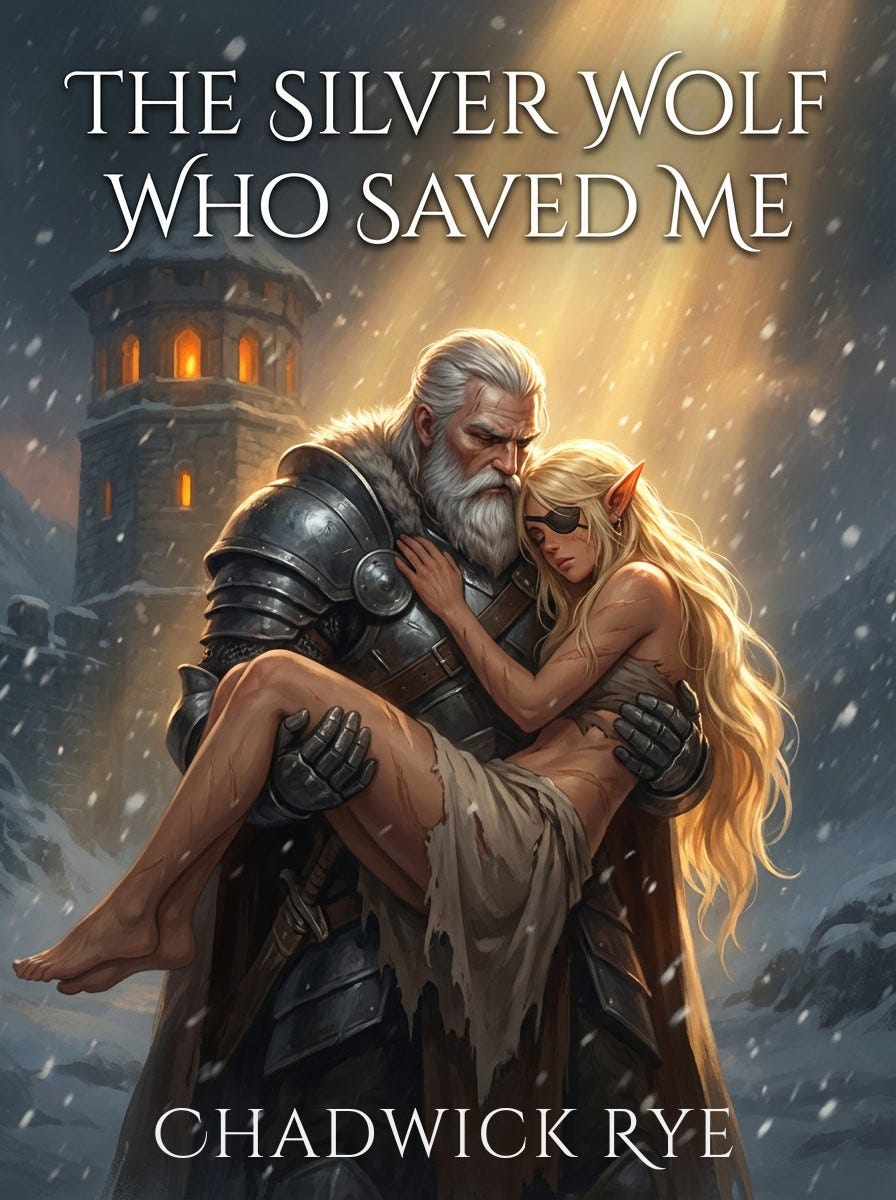
Being the second entry in the personal chronicle of Esbeth Ironwood, formerly of Aruel in the Sun Lands, now Lady of Stonewatch Tower and its surrounding lands, written in the twenty-fifth year since my liberation.
The prompt before me today asks: What relationships have a positive impact on you?
I find myself smiling at the parchment, though the expression still feels foreign on my face even after all these years. There was a time when I had forgotten how to smile entirely. When the muscles required for such simple expression had atrophied from disuse, leaving my face a mask of careful blankness designed to invite neither attention nor punishment. Smiling had been dangerous once. Joy had been dangerous. Any emotion beyond dull compliance had been an invitation for correction.
Rosco taught me to smile again. Not through any deliberate lesson—he was not that sort of teacher—but through the slow accumulation of moments where smiling became safe. Where joy did not invite pain. Where I could feel something other than fear and not be punished for the transgression.
But I am getting ahead of myself. The prompt asks about relationships, and while Rosco is the obvious answer, the complete answer is more complex. Let me return to those first days in the watchtower, when relationship meant nothing to me but the dynamic between owner and owned.
She woke to warmth and the smell of cooking meat, disoriented as fifteen years of captivity had taught her to be.
But this warmth was different. It pressed against her skin like a living thing, gentle and constant, carrying none of the damp chill that had been her companion for weeks. She could not remember a time before the cold. Could not remember what it felt like to be truly warm.
She opened her one working eye. The other had swollen shut sometime during her weeks alone in the flooded cell, crusted with infection that made the lid feel as though it had been sewn to her cheek.
The tower room materialized around her in fragments. Stone walls curved upward, ancient and solid, lit by firelight that danced shadows across their surfaces. A heavy cloak covered her as she lay on a soft bedroll—fur-lined, smelling of woodsmoke and horse and perhaps old blood. Beside her, flames crackled in a makeshift hearth, and above them hung an iron pot from which the smell of cooking emerged. Real food. Meat and herbs and something that might have been root vegetables.
And sitting in a chair to her right, watching her with pale gray eyes that reflected the flames like storm clouds lit by lightning, was the mountain who had carried her from the dark.
Memory returned in fragments. The flooding cell. The torn door. Snow falling silently as massive arms lifted her from the water. She had been dying, and then she had not been dying, and she still did not understand why.
The man—she did not yet know his name—did not move when he saw her wake. Did not rise or approach or make any gesture that might be interpreted as threat. He simply sat there, massive frame folded into a position that somehow made him seem smaller, less imposing, and waited.
He was enormous in a way that defied her experience. Seven feet of dark armor and white hair and scarred flesh. The scars alone should have warned her—no man accumulated that many marks without knowing intimately how to inflict them. His face looked carved from the same stone as the tower around them, weathered and hard, softened only slightly by the white beard that covered his jaw.
When he stood to bring her food, terror seized her with claws she thought had been dulled by years of abuse. But no—this was different. This man was different. He was a wall of muscle and scar tissue that blocked out the firelight as he rose. Every instinct screamed at her to flee, to hide, to make herself small and invisible and unworthy of attention.
She tried to scramble backward. Her body refused to obey. All she managed was a pathetic twitch, a whimper that escaped her cracked lips before she could trap it behind her teeth.
He stopped moving.
“I’m bringing you food,” he said. His voice was low and rough, like stones grinding together. “Nothing more. I’m not going to hurt you.”
She did not believe him. Could not believe him. But she was too weak to fight, too sick to flee, and too exhausted to do anything but watch as he retrieved a wooden bowl and filled it from the pot. The ladle scraped against iron. Steam rose in curling wisps. The smell hit her like a physical force, and her stomach cramped with desperate, painful need.
He crossed toward her.
She flinched so hard her vision went white at the edges.
He stopped again. Then he set the bowl on the stone floor and slid it toward her with one massive hand before retreating to his chair.
He did not watch her eat. Instead, he picked up a piece of leather armor and a needle and began to mend, attention focused on the work rather than on her.
The bowl sat there, steaming, impossibly close. She stared at it for a long moment, waiting for the trap to spring. Waiting for him to laugh and take it away, or to demand something in exchange, or to reveal whatever cruelty hid behind this performance of kindness.
Nothing happened.
She tried to eat.
Pulling herself up shakily, she reached for the bowl with hands that trembled so badly she could barely grip the spoon. Broth sloshed over the edges, spilling onto the bedroll, onto her borrowed tunic. She managed a few sips, a few bites of softened meat, before her stomach—empty for three weeks except for the filthy water that had pooled in the corners of her cell—cramped violently.
She vomited. Not much—there was nothing in her—but the heaving was painful and humiliating. The sound of it echoed off the stone walls, and when it was done she curled into herself, into a tight ball, arms wrapped around her wasted frame.
Waiting for punishment.
Wasting food was always punished. Always. She had learned that lesson so many times the knowledge lived in her bones now, deeper than thought. Waste invited correction. Correction invited pain. Pain was the only constant in a world that offered nothing else.
But he did not punish her.
He did not even raise his voice as he set his armor down and rose from his chair. His footsteps were heavy on the stone floor, each one sending tremors through the ground that she felt in her chest. She heard him cross the room. Heard him stop in front of her bedroll.
She glanced up through the curtain of her matted hair and saw his towering figure above her, a cloth in his massive hands. She tightened into a fetal position, squeezing her eye shut, waiting for the harsh words and the beating to begin.
Instead, he ignored her entirely.
He reached past her and picked up the bowl and spoon, setting them off to the side. Then he knelt—the motion surprisingly quiet for a man his size—and began to clean up the spilled broth and vomit with methodical, efficient movements.
She could feel herself shaking. Could not stop shaking. The fear was a living thing inside her, coiled around her spine, squeezing her lungs until each breath came short and shallow.
He noticed. She saw his eyes flick toward her, saw something shift in his expression. When he spoke, his voice was softer than before, and the words came in rough, badly-accented elvish.
“Don’t worry. I figured that would happen.”
The elf girl heard the words. But years of abuse kept her from believing them.
He spent the next few minutes cleaning in silence. Then he stood, gathered the soiled cloths, and left. She heard a door shut somewhere below. Heard his heavy footsteps descending the circular staircase.
She lay there on her bedroll, feeling awful.
Her stomach cramped and growled loudly, angry at being denied even the small amount of nourishment she had managed to swallow. The tower was quiet except for the crackling of the fire and the howl of wind against ancient stone. She was alone.
She had been alone for three weeks in that flooding cell. Had grown used to the sound of her own breathing, the drip of water, the distant scurrying of rats. This silence was different. Warmer. But silence nonetheless.
Then she heard the door open below. Heavy footsteps on the stairs, climbing steadily. He appeared moments later, the bowl and spoon in his hands, now clean.
He crossed the room toward her again.
She flinched again, waiting for the blow that would surely come this time. She had wasted his food. Had made a mess on his floor. Surely he would punish her now that he’d had time to consider her transgression.
Instead, he knelt beside her and reached out with surprising gentleness. His hands—massive, scarred, capable of violence she could only imagine—slid beneath her arms and lifted her as though she weighed nothing at all.
“Here,” he said. “Try to lean against this.”
She flinched and flinched again as he positioned her against a barrel near the wall, propping her up so she was no longer lying flat. Her head swam with the change in position. Her vision blurred at the edges.
“Esbeth is sorry,” she stammered in elvish, the words tumbling out before she could stop them. “I’ll be a good elf. I didn’t mean to waste food. Please. Esbeth will be better.”
She heard herself speaking in third person, the way she had been trained to speak. Slaves did not deserve the dignity of “I.” Slaves were things, objects, discussed in the same terms as furniture or livestock.
“Hush now, girl,” he replied in that same rough elvish. The consonants were wrong. The vowels were flat. But the meaning was clear enough. “I’m not going to hurt ya.”
He released her once she was stable against the barrel, then turned to the iron pot hanging over the fire. This time, he scooped only broth into the bowl. No meat chunks. No vegetables. Just the clear, golden liquid, steam rising from its surface.
He returned to her and knelt again, bringing the spoon to her mouth.
She refused. Kept her gaze averted, staring at the stone floor, at the hem of his dark cloak, at anything except his face. Opening her mouth meant accepting something from him. Accepting something meant owing something. Owing something meant payment would be extracted later.
“Come now, girl,” he said. “You need to eat. Ya look like a half-starved orphan.” A pause. “Hell, worse than that.”
Still she refused. Not out of anger. Not out of defiance. Out of fear so deep it had become reflex, written into her muscles and bones by fifteen years of careful training.
He reached out with one massive hand and gently turned her face toward him.
“Look at me, elf.”
His voice carried command now. Not cruelty—she knew what cruelty sounded like—but authority. The voice of someone accustomed to being obeyed.
She met his eyes. Storm gray, fierce, hard as the mountains themselves. It was difficult to hold his gaze. Everything in her screamed to look away, to submit, to make herself small and unthreatening. But something in his expression held her there.
“I’m trying to help ya, girl.”
He picked up the spoon and brought it to her lips.
“Now open up and let me feed ya. Don’t worry—it’s not poisoned, and it’s only broth this time. Your stomach should be able to handle a little bit of it.”
She stared at him, searching for the lie. The deception. The hidden cruelty waiting to spring.
She found nothing but patience.
Slowly, hesitantly, she opened her mouth.
The broth was warm and rich, tasting of beef and marrow and herbs she couldn’t name. He fed her one spoonful at a time, waiting between each for her to swallow, never rushing, never showing frustration at her slowness. The warmth spread through her chest, her stomach, her limbs.
Tears began to stream down her face.
She did not know why she was crying. Could not have explained it if asked. The tears simply came, silent and unstoppable, tracking lines through the grime on her hollow cheeks as he continued to feed her.
He did not comment on them. Did not try to comfort her or make her stop. He simply continued, spoonful after spoonful, until the bowl was empty.
Then he set it aside.
“Do you need to use the chamber pot?”
She nodded, too exhausted for words.
He helped her to it—half-carrying her across the room on legs that refused to support her weight—then left without being asked, giving her privacy she had not known in years. She could not remember the last time someone had left her alone for such a simple, human need. Could not remember the last time her body had been treated as something other than property to be used as others saw fit.
When he returned, he helped her back to the bedroll. His hands were careful, clinical, touching her only as much as necessary to move her from one place to another.
She was feeling worse now. Much worse. The brief exertion had drained what little strength she had, and something else was wrong. Something deeper.
Rosco noticed. He reached out and pressed his palm to her forehead, and even through the haze that was beginning to cloud her thoughts, she saw his expression darken.
“You’re burning up,” he said. “Fever.”
She wanted to respond. Wanted to ask what that meant, what would happen now, whether fever was something that invited punishment. But the world was starting to spin around her, the edges of her vision going soft and strange, and before she could form the words she was falling backward into darkness.
Time fragmented.
She was burning from the inside. Cold and hot simultaneously, her skin so fevered that the warm air in the tower felt like ice against it. She thrashed against blankets that tangled around her wasted limbs, fighting enemies that weren’t there, fleeing from hands that existed only in memory.
Dreams blurred into waking nightmares. Faces from her past swam before her—masters and captors, buyers and sellers, the endless parade of people who had owned her and used her and discarded her. Hands reaching for her. Voices demanding things she couldn’t give.
She cried out in languages she didn’t consciously choose. Elvish. Common. Fragments of slaver’s pidgin she had learned in the markets where her kind were bought and sold like cattle.
“Please,” she heard herself begging. “I’ll be good. I’ll be better. Please stop hurting me. Please.”
Through the haze, a voice.
Low, deep, gravelly. Speaking elvish badly—the consonants wrong, the vowels flat. But the words themselves were gentle.
“Calm down, elf. You’re safe. No one will hurt you. Rest.”
A cool cloth pressed against her forehead. The relief was so sharp it made her gasp, cutting through the fever-heat like water through fire. She tried to focus on the shape above her, tried to make sense of what she was seeing.
Massive. Terrifying. White hair catching the firelight from the hearth.
But the hands holding the cloth were careful. Gentle. They did not grab. Did not hurt.
She slipped back into fever-darkness, confused.
She surfaced again to find him kneeling beside her.
Not looming—kneeling. Making himself smaller, though a man his size could never truly be small. He had a cup in his hands, steam rising from whatever was inside.
“It’s broth,” he said, following her gaze. He spoke in common tongue this time, perhaps because she seemed more lucid. “You’re very weak. You need to eat something. It’s broth made from beef bones. Has marrow in it. It’ll restore your strength and help your stomach.”
She tried to take the cup. Her hands wouldn’t cooperate—shaking, weak, fingers that felt disconnected from her intentions. Her head swam as she tried to move, and the cup tipped dangerously.
“No,” he said, steadying it. “You’ll spill it. I’ll feed you.”
He grabbed a clean cloth and twisted it into a pseudo-ball, then dipped it into the broth. When it was saturated, he brought it to her lips.
“This way. Suck on the cloth. Drink what you can.”
It was an odd method, but it worked. She sucked the warm liquid from the cloth, and her stomach—so violent in its rejection before—accepted it without complaint. He dipped the cloth again and again, patient, unhurried, until the cup was empty.
As she lay there, the warmth spreading through her failing body, she found herself wondering why.
Why was he helping her?
Why wasn’t he angry?
What did he want that he hadn’t taken?
But she was too weak and too hungry to refuse his care. Too sick to do anything but accept what was offered and wait for the price to be revealed.
Perhaps a few days later—she had lost track of time—she was doing better. The fever had retreated, leaving her weak but lucid. She could stay awake for longer stretches. Could follow conversations. Could think.
But something was wrong with her eye.
The left one, the one that had been swollen shut since the dungeon. It had been covered with a leather patch, and she had assumed it was healing beneath. But now the man was kneeling above her, and he had removed the patch, and his expression was grim.
“It’s bad, elf,” he said. His voice was matter-of-fact, but she heard something beneath the words. Concern, perhaps. Or resignation. “That eye is badly infected. Won’t clear up despite the doctoring I’ve done to it. I’ve seen things like this after battles—gets infected and festers.” He paused. “A mage could heal it, but unfortunately for you we’re leagues away from any healing mage.”
He met her gaze with his storm-gray eyes.
“I’m going to have to remove it.”
Fear seized her like a physical force. She began shaking her head, whimpering, shrinking back against the bedroll as though she could escape through the stone floor beneath her.
“No,” she managed. “Keep eye. Please. Keep eye.”
He sighed. “Ya can’t. It’s likely the cause of that fever. It’s beyond saving.”
“No.” She was crying now, tears streaming from her one good eye. “Please. Esbeth will be good. Esbeth will—”
“Listen to me, girl.” His voice cut through her panic, firm but not cruel. “I’ve done this before. More times than I’d like. You’ll be fine without it. But if I leave it in there, you’re going to get very sick again. And this time, it’ll kill you.”
He reached over to a small table beside her bedroll and picked up a spoon with some dark liquid pooled in its bowl.
“Here. Swallow this. It’ll help with the pain.”
She refused, turning her head away. The fear was overwhelming now, drowning out reason, drowning out everything except the primal certainty that she was about to be hurt.
He sighed again. She heard frustration in it this time, and something else. Weariness, perhaps.
“Trust me, elf. You’re gonna want this.” His voice hardened. “Either you take it, or I hold ya down and take your eye out the hard way.”
She heard the scrape of metal as he drew a knife from his belt. It was large, wickedly sharp, catching the firelight along its edge.
She stared at him. At the knife. At the spoon of dark liquid.
“It’s your choice,” he said. “The easy way or the hard way. But I’m not leaving that thing in your head to poison you from the inside.”
She could see he hated this. Could see it in the set of his jaw, the tension in his shoulders. He was using fear against her, and he didn’t like it. But he was doing it anyway, because he believed it was necessary.
Slowly, her hand shaking so badly she could barely control it, she reached out and took the spoon.
The liquid was bitter on her tongue. She swallowed it with a grimace, and almost immediately felt a heaviness descending over her thoughts. The edges of the room went soft. The fear receded, muffled by whatever drug was spreading through her blood.
A final fearful thought entered her mind—what if he doesn’t stop at the eye—and then she slipped into oblivion.
When next she woke, the first thing she did was raise her hand to her left eye socket.
The leather patch was in place. But beneath it, where her eye had been, there was only emptiness. A hollow space, tender and strange, that her fingers explored with dawning horror.
“It’s gone, girl.”
His voice came from his chair near the hearth. She turned her head—slowly, carefully, the motion making her dizzy—and saw him sitting there, that same piece of armor in his hands.
“I took it while you slept,” he continued. “Figured that was the best way. The safest.” He set the armor aside and met her gaze. “You look like you’ve been through enough shit. Didn’t want to put you through that too.”
A tear rolled down her right cheek. Then another. She lay there on her bedroll, one hand still pressed to the patch covering her empty socket, and wept in silence.
He let her cry. Did not try to comfort her or tell her it would be alright. Did not offer false reassurances or empty platitudes. He simply returned to his work, giving her the space to grieve what she had lost.
After a while, he rose and brought her food. She ate mechanically, barely tasting it, and then she slept again.
Days blurred together after that.
She lost count of them as she lay beneath the heavy blankets on her soft bedroll beside the warm fire that the large man kept constantly fed. Outside, snow fell in endless curtains of white. The wind howled against the ancient stones. Winter had the tower in its grip, and there was nowhere to go even if she had the strength to leave.
Slowly, very slowly, things began to shift.
She kept more and more broth down. Then a few bites of bread softened in broth. Then a small piece of meat, chewed carefully, her stomach accepting what it had once rejected. The empty eye socket, so raw and tender in those first days, began to heal. He changed the dressing regularly, applying salves that smelled of herbs and something sharper, and she learned to hold still while he worked.
She started staying awake for longer stretches. An hour. Then two. Then most of the day, though exhaustion still claimed her early each evening, pulling her down into sleep before the fire had burned low.
She watched him.
He moved around the tower with efficient, economical movements. Nothing wasted. He cooked—simple, hearty meals that asked little of her recovering stomach. He mended—armor and clothing and the various tools of a life she did not yet understand. He tended the fire with the ease of long practice, knowing exactly when to add wood and how much.
She noticed things.
The way he favored his left side slightly, as though nursing an old injury that had never fully healed.
The missing finger on his right hand—the pinky gone, leaving only smooth scar tissue where it had once been.
The way he talked to himself sometimes, low muttering she couldn’t quite make out. She wondered if he was lonely. If the silence of this tower weighed on him the way it might weight on anyone. Or if he preferred it this way, alone with his thoughts and his work.
He caught her watching once. Met her eye briefly, holding the contact for a moment longer than necessary.
Then he returned to his work without comment.
She didn’t know what to make of him. The framework she had for understanding men—for understanding anyone—didn’t fit. He should want something. Everyone wanted something. She had learned that lesson in the hardest possible ways. Kindness was currency. Care was investment. Nothing came without price.
But days passed, and he asked for nothing. Took nothing. Simply provided. Simply cared.
It terrified her more than cruelty would.
Cruelty, at least, she knew how to expect.
One day, he was changing the dressing on a wound at her shoulder. One of many she had stopped noticing long ago—a cut that had become infected, then scarred over improperly, then opened again in the dungeon’s damp. His hands moved with practiced efficiency, cleaning the wound, applying salve, wrapping it in fresh cloth.
“Thank you.”
The words came out cracked. Barely audible. She wasn’t even sure she had said them until he paused, his hands going still against her skin.
He didn’t make a big deal of it. Didn’t exclaim or celebrate or treat it as a breakthrough. He just nodded, once, and continued with the bandage.
“You’re welcome,” he said.
But she saw something shift in his expression. Something that might have been relief, or satisfaction, or something else entirely. It was gone before she could name it, hidden behind that weathered, scarred face.
They finished out the day in silence and peace.
Another day dawned, and she was strong enough to sit up on her own.
To feed herself, though her hands still trembled from time to time.
To stay awake through most of the day, though exhaustion still claimed her before full darkness fell.
Strong enough to think.
And thinking brought questions.
He had moved her to a chair—a plush, comfortable thing that looked entirely out of place in the sparse tower room. When she had looked at it with obvious confusion, he had shrugged and said he’d found it in the dungeon below. Brought it up specifically for her, so she wouldn’t have to lie on her bedroll all the time.
She sat in that chair now, watching him nearby. This mountain of a man with his white hair and beard, his scars and his terrible elvish. He was reading something—a book that looked comically small in his massive hands—and the firelight from the hearth caught the pale lines that marked his face. Each scar was a story she didn’t know. Each mark was a mystery.
The question built in her chest like pressure behind a steam valve.
She couldn’t help herself.
“Why?” she blurted out in elvish.
The man stopped reading and looked at her. His expression was unreadable, patient, waiting.
“Why what, girl?”
“Why did you save me?” She locked her single eye with his two, holding his gaze with a fierceness she didn’t know she still possessed. “Why not leave me there to die? I was ready for it. I had made my peace with it.”
He scoffed—a rough sound, almost a laugh but not quite. He set the book down on a small table beside his chair.
“Made your peace with it, did ya?” His voice was dry, skeptical. “Didn’t look that way to me, girl.”
Something rose in her. Something hot and sharp that she hadn’t felt in years. Anger.
“It’s true!” The words came out louder than she intended, almost a yell. “I wanted it. I’ve wished for it forever, and when it finally arrived you show up and ruin it!”
Her voice dropped, going quiet and broken.
“I was finally going to be free.”
She hung her head as sobs began to shake her thin shoulders.
“Now I’ll never be free.”
The man was silent for a long moment. When he spoke, his voice was different. Softer, perhaps. Or harder. She couldn’t tell.
“Don’t be so quick to seek death.” He rose from his chair and walked toward the hearth, his boots heavy on the stone. “I’ve brought it to many. Even those asking for it.”
He opened the pot hanging over the fire and began ladling food into a wooden bowl—chunks of meat and potatoes this time, more substantial than the broth she had been surviving on.
“It’s never what they think it is,” he continued, tearing a piece of bread from a loaf and setting it atop the meat. “Nor do they ever look free.”
He crossed to her chair and placed the bowl in her lap gently. The weight of it was grounding, real.
“The name’s Rosco,” he said. “And I saved ya because ya needed saving.”
He knelt down, bringing himself to eye level with her. She flinched instinctively, cowering back against the chair, waiting for him to hit her for her insolent tone. She had yelled at him. Had challenged him. Had shown anger, and anger was always punished.
But he didn’t hit her.
She opened her eye to find him just staring back at her, those storm-gray eyes calm and steady.
“Eat, elf,” he said. “I’ll not lay a finger on ya.”
He pointed at the bowl in her lap.
“And other than thinking that ya didn’t deserve death, I saved ya for my own reasons.”
He stood, rising back to his full, intimidating seven feet. She had to crane her neck to look up at him, and for a moment the old fear surged—the certainty that she was small and he was large and anything he wanted to do to her he could do without effort.
But he just turned and walked back to his chair. Before he sat, he reached into a box on the table beside it and withdrew a cigar. He lit it with a taper from the fire, took a few slow puffs, and settled back into his seat with the book in one hand.
She stared at the food in her lap for a long moment.
Then, slowly, she began to eat.
The meat was tender. The potatoes were soft. The bread soaked up the juices and dissolved on her tongue like something from a dream she had forgotten she once had. She ate and cried at the same time, tears running down her face as she filled her stomach with food that had been given freely, without cost, without demand.
When she was nearly finished, she spoke again.
“Esbeth.”
He looked up from his book, one eyebrow raised. The cigar smoldered between his fingers.
“What’s that, elf?”
She stammered, her voice catching on syllables that should have been easy. “Es—Es—” She swallowed, tried again. “My name is Esbeth.”
Something shifted in his expression. Something warm, though she wouldn’t have known to call it that. He smiled—just slightly, just a small quirk of the lips—and took another puff from his cigar.
“Nice to meet ya, Esbeth,” he said.
She sat there, bowl in her lap, tears on her cheeks, and for the first time in fifteen years she had given her name to someone who had bothered to ask.
What relationships have a positive impact on you?
I set down my quill and stare at the words I have written. The memories are so vivid still, even after all these years. The fever. The fear. The taste of bone broth on a cloth pressed to my lips. The weight of that bowl in my lap, the first real meal I had been given rather than earned.
I did not trust him then. Could not trust him. Fifteen years had taught me that trust was a trap, that kindness was currency, that nothing—nothing—came without cost.
But something had begun. Something small and fragile, easily crushed. A seed planted in scorched earth, unsure if it would find purchase.
His name was Rosco. My name was Esbeth. And for reasons he called his own, he had decided I was worth saving.
I did not understand it then. Did not believe it. Winter stretched ahead of us, long and cold and full of questions I was not yet ready to ask and he was not yet ready to answer.
But I was alive. I was healing. And the man who had pulled me from the drowning dark asked nothing of me but that I eat, and rest, and allow myself to mend.
It would be weeks more before I understood what that meant. Months before I trusted it. Years before I could name what he had given me.
But here, in this chapter of memory, we had exchanged names. And in that small act, we had become something more than stranger and stranger.
We had become the beginning of something.
What that something would grow into—that is a story for another entry.