The Silver Wolf Who Saved Me: Chapter 3: Small Things
Chronicle Entry Three

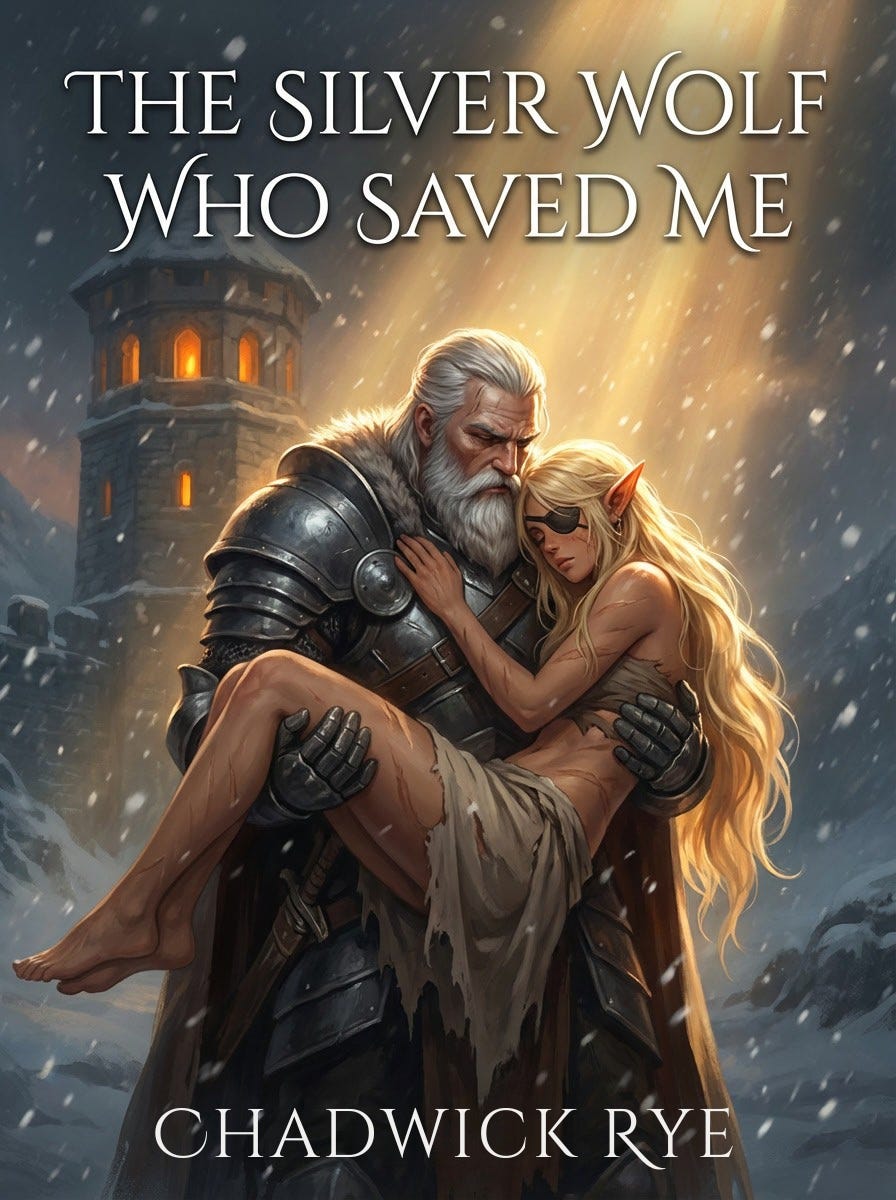
Chronicle Entry Three
Being the third entry in the personal chronicle of Esbeth Ironwood, formerly of Aruel in the Sun Lands, now Lady of Stonewatch Tower and its surrounding lands, written in the twenty-fifth year since my liberation.
The prompt before me today asks: What small gesture has meant the most to you?
I sit with this question for a long while, quill hovering above parchment. There are so many answers. So many moments that accumulated into something larger than themselves. But if I am honest—truly honest—the gestures that meant the most were not always gentle ones. Sometimes the greatest kindness came wrapped in blood and fire, in commands that sounded harsh but carried love beneath their edges.
Let me return to those early days. To the storm, and what came after.
She had taken to sleeping in the chair.
It was easier than the bedroll, somehow. More comfortable. She could curl into it, pull her knees to her chest, wrap herself in the soft fur blankets he had given her until she was nothing but a small lump of warmth beside the fire. The chair was large—comically large, built for a man of his proportions rather than an elf of hers—but that made it better. She could disappear into it. Could make herself small and hidden and safe.
She was still exhausted. Still falling asleep before full darkness claimed the sky, her body demanding rest it had been denied for years. But she was staying awake longer now. An hour. Then two. Then most of the afternoon, watching him move about the tower, learning the rhythms of his days.
She did not speak much. Not after the last time, when she had demanded to know why he saved her and he had given her an answer that was no answer at all. For my own reasons. The words sat in her chest like stones, too heavy to lift, too sharp to ignore.
Instead, she watched. And she noticed things.
Her fingers found the braid in her hair—she did this often now, a nervous habit she had developed without realizing. The pattern was intricate, more complex than anything she could have managed with her own clumsy hands. Three strands woven into five, then back to three, with small loops at the temples that kept the hair from falling into her face.
Someone had taught him this. Someone had sat with this massive, scarred warrior and shown him how to braid hair with gentle fingers. A mother, perhaps. A sister. A lover long dead.
She looked at him across the room, where he sat mending a tear in his cloak, and wondered what other softnesses hid beneath that weathered exterior.
The sky began to darken early that afternoon, and not from the setting sun.
Esbeth watched through the frost-rimed window as clouds piled against the mountains like waves against a breakwater. They were heavy and gray and pregnant with snow, moving faster than clouds should move, driven by winds she could not yet feel. The light outside had taken on a strange greenish cast, the kind that came before the worst storms. Even through the thick stone walls, she felt the air change—a heaviness, a pressure that made her ears pop.
Rosco noticed her watching. He set aside his mending and rose, crossing to the window to stand beside her. She tensed at his proximity—she always tensed, even now—but he kept a careful distance, his eyes on the sky rather than on her.
“Storm coming,” he said. “A bad one, by the look of it.”
He turned and began to move with some purpose.
She watched as he descended the stairs, then returned carrying an armload of firewood. He stacked it against the wall near the hearth, then went down again. And again. And again. Bundle after bundle, until the woodpile had grown to three times its previous size. Then he checked the shutters, tested the door, stuffed rags into cracks she hadn’t noticed.
On one of his passes, he caught her looking at him with what must have been obvious concern. She glanced at the window, then back at him, her single eye wide.
“It’s alright,” he said, his rough elvish slightly less terrible than it had been weeks ago. “Just getting ready. Nothing to fear.”
She wanted to believe him. She was not sure she could.
The storm hit a few hours later, as they sat eating supper.
One moment the wind was a distant moan against the stones. The next, it was a living thing—howling, shrieking, hurling itself against the tower with a fury that made the flames in the hearth gutter and dance. Snow came with it, driving against the windows in sheets so thick she could see nothing beyond the glass but swirling white.
The tower held. Of course it held. It had been built by hands that understood stone, in an age when buildings were made to last centuries. The walls were thick enough to muffle the worst of the wind’s rage. But she could hear boards rattling somewhere above them—the roof, perhaps, or a shutter that had worked loose—and each clatter made her flinch.
Rosco noticed. He always noticed.
“Just a bit o’ wind,” he said around a mouthful of stew. “Tower’s weathered worse than this. We’re safe.”
She tried to take his advice. Tried to focus on her food, on the warmth of the fire, on anything except the howling darkness beyond the walls. She managed a few more bites before exhaustion claimed her, pulling her down into the depths of the chair until she was nothing but a small shape beneath the furs.
She looked so small there. So fragile. A child’s form in a giant’s chair, swallowed by blankets that could have wrapped around her three times over.
The fire crackled. The wind screamed. And Esbeth slept.
The nightmare came for her in the dark hours of the night.
She was young again—young in the way of elves, which meant she had seen perhaps thirty summers but wore them like a human girl of sixteen. The dungeon smelled of mold and human waste and fear. The shackles were new on her wrists, the iron still cold and unfamiliar, grinding against the raw flesh where she had fought them for days. The brand on her shoulder was still raw and weeping, each breath pulling at the burned skin.
She could smell the ale on his breath as he leaned close. Could count the yellowed teeth in his smile. His boots—heavy leather, spattered with old blood—stopped inches from her face.
“You dare to fight back?” His voice was thick with drink and something uglier, something that made her stomach turn. “You dare to raise your hand against your betters?”
She had fought back. Scratched his face when he reached for her. Drew blood. In those early days, before they broke her, she had still believed that fighting mattered. Had still thought that if she just resisted hard enough, long enough, someone would come. Someone would save her.
No one had come.
The whip uncoiled in his hand like a sleeping snake coming awake. She could hear the leather hiss as it cut through the air—
A thunderous bang split the night.
Esbeth jerked awake, gasping, her heart slamming against her ribs like a caged animal. For a terrible moment she didn’t know where she was. The dungeon. The markets. The countless rooms where countless men had—
Firelight. Stone walls. The smell of woodsmoke.
Rosco.
He was awake too, sitting upright in his chair across the room, his eyes scanning the shadows. The bang had woken him as well. She could see the tension in his shoulders, the way his hand had moved instinctively to where his sword rested against the arm of his chair.
Then his gaze found her, and his expression shifted.
“Easy,” he said in that rough elvish. “Easy, girl. You’re safe. It was just the wind.”
She was shaking. Couldn’t stop shaking. The nightmare still clung to her like cobwebs, the phantom pain of the whip burning across her back even though those scars were years old.
He rose and crossed to the hearth, his movements slow and deliberate. She watched him add logs to the fire, watched the flames rise and the warmth spread, and slowly—so slowly—her breathing began to steady.
“What was that noise?” she managed when she could speak.
He shook his head. “Don’t know yet. Nothing’s come through the door or the walls, and the horse isn’t screaming. Whatever it was, it can wait until morning.” He settled another log onto the flames, then straightened. “Try to sleep. I’ll keep watch.”
She wanted to argue. Wanted to stay awake, to guard against whatever had made that sound. But her body had other ideas. The fire was warm, the blankets were soft, and exhaustion was a weight she could not fight.
She slept.
This time, the nightmares did not find her.
Morning came gray and quiet, the storm having blown itself out sometime before dawn.
Esbeth woke to the smell of cooking meat and the sound of fat sizzling in a pan. She opened her eye to find Rosco crouched by the hearth, turning slices of pork with a long fork. Eggs waited in a bowl beside him. Bread sat on a wooden cutting board, already sliced.
“Good morning,” he said without turning around.
She uncurled from the chair slowly, her muscles stiff from sleep. The fire had burned low during the night, but he had rebuilt it at some point, and the tower room was warm enough that she didn’t shiver when the blankets fell away.
He served breakfast on wooden plates—pork and eggs and thick slices of bread, more food than she had eaten in a single meal for as long as she could remember. She ate slowly, carefully, her stomach still learning to accept nourishment without rebellion.
The water he gave her came in a wooden mug. It was well-made, carved with simple geometric patterns along the rim, but it was sized for his hands, not hers. She had to grip it with both palms, and even then it was awkward, the weight of it threatening to tip with every sip.
She saw him watching her struggle. Saw something flicker across his expression—a note made, a problem identified. He said nothing, but she knew he had noticed.
After breakfast, he rose.
“Going to check on Burden,” he said. “And see what made that noise last night. You know where the chamber pot is.”
He descended the stairs, giving her privacy for her morning needs. She had grown almost accustomed to this—the way he left without being asked, without making her request something so basic as a moment alone with her own body. It should not have felt like kindness. It should have been the barest minimum of human decency.
It felt like kindness anyway.
She was just settling back into her chair when she heard him coming back up the stairs.
His footsteps were faster than usual. Harder. When he emerged into the room, his face was set in hard lines and his hand was reaching for the sword that leaned against the wall.
“Stay inside,” he said. “Away from the windows.”
“What—”
“Stay. Inside.”
He grabbed the sword and was halfway back down the stairs before she could form another word. The last thing she heard him say, growled under his breath, was a word she had heard before in Common but never with such venom.
“Blasted troll.”
She should have listened.
She should have stayed in her chair, wrapped in her blankets, eyes fixed on the fire. He had told her to stay inside. To stay away from the windows. His voice had carried command, and she had been trained for fifteen years to obey commands without question.
But something pulled her to her feet. Something dragged her across the room to the frost-covered window on the left side of the tower. She wiped a circle clear with her palm and peered through, her breath fogging the glass.
Nothing. Just snow, pristine and white, covering everything in a blank canvas.
She moved to the right side window. Cleared the frost. Looked out.
And saw the monster.
It was as tall as Rosco—perhaps taller—a grotesque thing of white fur and gray flesh, with arms that hung past its knees and a face that belonged in nightmares. Three eyes sat in a triangular arrangement above a mouth full of teeth like broken gravestones. Its body was ape-like, hunched and powerful, and it moved with a shambling gait that was somehow faster than it looked.
Rosco was walking toward it.
Just walking. Sword in hand, steam rising from his breath in the cold air, as though approaching a rabid beast twice his weight was nothing more than a morning chore.
The troll saw him and roared—a sound that shook snow from the nearby branches and rattled the glass in the window frame. Then it charged.
Esbeth’s hand flew to her mouth.
She watched Rosco meet the charge without flinching. His sword came up in a silver arc and bit into the troll’s shoulder, cutting deep into muscle and bone. Blood sprayed—red against white, shockingly bright—and the creature howled in pain.
But even as she watched, the wound began to close. The flesh knitting together, the blood slowing, the gash disappearing as though it had never been
Rosco didn’t seem surprised. He swung again, and again, driving the beast back with blows that would have killed any mortal creature. His sword opened cuts across its chest, its arms, its face. Each one healed within seconds.
Then he changed tactics.
A particularly powerful swing took the troll’s arm off at the elbow. The limb fell into the snow, fingers still twitching, and the creature stumbled backward with a shriek of fury. But even as it retreated, she saw something horrible happening at the stump—new flesh bubbling up, bone extending, a new arm beginning to form.
The troll charged again.
This time, it hit him.
Esbeth cried out as Rosco went down, the troll’s massive body bowling him over into the snow. She saw him disappear beneath the creature, saw those terrible clawed hands reaching for his throat—
Then the troll lurched sideways, as if struck by an invisible hammer. Rosco rolled clear in an explosion of snow and blood, his movements impossibly fast for a man his size. Before the creature could recover, he was behind it, and his sword punched through its back with enough force to emerge from its chest.
The creature roared and tried to turn, but Rosco was already moving. She saw him draw that massive knife from his belt—the one he had shown her when he took her eye—and in one brutal motion he grabbed the troll’s head from behind and pulled it back.
The knife went to the creature’s throat.
It was not a quick cut.
She couldn’t look away. Couldn’t close her eye. Could only watch as Rosco began to saw, his whole body straining with the effort, blood spraying across his hands and arms and face. The troll thrashed and gurgled and made sounds no living thing should make. Rosco kept cutting.
Then, with a final roar of effort, he pulled.
The head came free.
He stood in the snow, breath heaving, the severed head dangling from one massive fist. Blood drip from the stump, painting the white snow crimson. The headless body collapsed and began to steam, flesh and bone dissolving into a puddle of foul-smelling ichor.
Rosco looked up.
His eyes found the window. Found her.
She stumbled backward, away from the glass, away from the sight of him. Her legs carried her to the chair without conscious thought. She wrapped herself in the blankets and pressed her face against the fur, trying to erase what she had seen, trying to reconcile the man who braided her hair with the man who had just ripped a monster’s head from its body with his bare hands.
She was still shaking when she heard the door open below.
His footsteps on the stairs were heavy. Slower than usual.
When he emerged into the room, she understood why.
He was covered in blood. It painted his hands, his arms, his face, his chest. Some of it was the troll’s—thick and dark, already beginning to dry in the warmth of the tower. But some of it was his own, streaming from cuts on his head, his face, his right arm.
In that hand, he still carried the head.
Esbeth shrank deeper into the chair, pulling the blankets up to her chin. He looked like something out of her nightmares—a monster himself, a creature of blood and violence, the kind of man who had hurt her so many times before.
He walked past her without a word, crossing to the fire. As he passed, the troll’s three eyes rolled toward her. Its mouth moved, making wet, gurgling sounds, even though its throat was gone, even though it had no lungs to push air through vocal cords.
It was still alive.
Rosco threw it into the fire.
The screaming started immediately. High and piercing and utterly inhuman, the kind of sound that would haunt her sleep for weeks. The head thrashed in the flames, mouth opening and closing, three eyes bulging as the flesh began to blacken and char.
Rosco watched it burn. His face was expressionless, but his eyes—his eyes were full of something she could not name. Hate, perhaps. Or satisfaction. Or simply the cold focus of a man completing a necessary task.
The screams died slowly. The head stopped moving. The flames consumed it, reducing it to bone and then to ash.
Rosco turned and walked to his chair.
He moved stiffly now, favoring his right side. When he lowered himself into the seat, she saw him wince. Saw him examine the deep gash on his arm—a wound that went to the bone, still bleeding freely.
He sighed, let his arm fall, and watched his blood drip onto the chair and floor.
“Blasted trolls,” he said in elvish. His voice was tired. “I hate the damned things.”
For a long moment, Esbeth just stared at him.
This man. This massive, bloodied, terrifying man. He had just killed a monster with his bare hands. Had ripped its head off and burned it alive. Had done so without hesitation, without fear, with the ease of long practice.
And now he sat in his chair, bleeding and exhausted, making no move to tend his wounds.
Her throat tightened. Her chest ached with something she had no name for, something that felt dangerous and precious at the same time.
Before she could think better of it, she was rising from her chair. Her legs were unsteady—she was still so weak, still recovering from weeks of starvation and sickness—but they carried her across the room to where the clean rags were stored. She gathered a handful, then retrieved a bowl from the shelf.
Rosco watched her. Said nothing.
She filled the bowl with water from the bucket and set it over the fire to heat, positioning it above the still-smoldering remains of the troll’s head. Her hands shook as she worked. Her whole body shook. But she didn’t stop.
When the water was warm enough, she poured in some cold to cool it for her hands. Then she carried the bowl and the rags to where Rosco sat.
“Ple...please, master.” The words came out before she could stop them, in the cadence she had been trained to use, the voice she had learned kept her alive. “Let me clean your wounds. Esbeth is good at cleaning. She was taught well.”
Rosco looked at her for a long moment.
She saw herself through his eyes: a ragged elf girl with barely any meat on her bones, dressed in rags that had once been a dress, her single eye wide with barely contained terror. She was shaking so badly the water in the bowl trembled. And yet she was here, offering to help him, when every instinct must have been screaming at her to hide.
“Stop speaking like that,” he said.
She flinched. His voice was harsh—harsher than he’d meant, perhaps, because she saw something flicker across his face when she took a step back.
“You’re an elf,” he continued, softer now but still firm. “Speak like one.”
“I...I’m sorry, master.” She couldn’t stop. The old patterns were too deep, carved into her by years of pain and repetition. “Esbeth was taught to speak this way. Esbeth is property. Esbeth must speak like property.”
She hung her head, making herself smaller. Unthreatening. The way she had learned to be in the presence of angry men.
“I’m not your master, Esbeth.”
She looked up. He was watching her with an expression she couldn’t read, his gray eyes steady despite the blood still running down his face.
“But you are,” she whispered. “You saved Esbeth. Fed her. Nursed her back to health. Kept her warm.” The question that had been building in her chest for weeks finally found voice. “Why else do that if Esbeth is not your property?”
Rosco sighed. He pinched the bridge of his nose with his unbloodied hand, leaving a smear of red across his face.
“This is going to be difficult,” he muttered. Then, louder: “Very well, Esbeth. Please proceed.”
He rolled up his sleeve, exposing the wound.
It was worse than she had thought. The gash ran from his elbow nearly to his wrist, deep enough that she could see the white of bone beneath the torn muscle. A lesser man would have been unconscious from blood loss. A lesser man might already be dead.
Rosco just sat there, watching her, waiting.
She knelt beside his chair and began to work.
Her hands remembered this. The countless times she had cleaned wounds for masters too cheap to pay for healers. The careful dabs to remove dirt and debris. The gentle pressure to slow bleeding. The precise wrapping of bandages to hold flesh together while it healed.
She was good at this. One of the few skills she had that anyone had ever valued.
When she finished with his arm, she moved to his head, cleaning the cuts on his scalp and face with the same careful attention. He held still for her, barely breathing, his eyes fixed on some point in the middle distance.
“You’re good at this,” he said when she was done.
It was not a question. She nodded anyway.
“I was taught. Masters did not want to pay for healers when a slave could do the work.”
She saw him flinch at the word. Saw his jaw tighten. But he said nothing.
Later, he took her downstairs.
She had never been to the bottom of the tower—had never been strong enough to manage the stairs, and he had always come to her rather than asking her to come to him. Now she descended slowly, one hand on the cold stone wall, legs trembling with the effort. The air grew colder with each step, the warmth of the hearth fading behind her.
At the bottom, there was a door. Beyond the door, there was a horse.
The stable smelled of hay and horse and old stone, warmer than she expected but still cold enough that her breath misted in the air. Burden was enormous. As black as midnight, with a mane that fell past her shoulders and eyes like polished obsidian. She was nearly as tall at the shoulder as Esbeth was standing, her hooves the size of dinner plates, her breath fogging in rhythmic clouds.
“This is Burden,” Rosco said. “We’ve been through a lot together.”
The horse turned to look at Esbeth. There was intelligence in those dark eyes—more intelligence than any horse she had ever seen. Burden huffed once, twice, the sound echoing softly in the enclosed space. Then she stretched her massive head toward the elf girl and waited.
Slowly, carefully, Esbeth raised her hand.
Burden’s muzzle was soft against her palm. Warm. Alive. The velvet texture of it, the gentle puff of breath against her skin that smelled of sweet hay and grain. The horse held still for a long moment, and Esbeth could feel the steady rhythm of her breathing, the solid warmth of her presence. Then Burden nickered softly—a sound like a question—and pressed closer, as though asking for more.
Esbeth stood there, her hand on the horse’s face, and felt something she couldn’t name. Not peace—not yet. But something close to it. A quiet moment in a life that had held so few of them. The cold air, the smell of the stable, the warmth of the horse—it was real. Solid. Safe.
Rosco watched them for a moment, then turned toward the door.
“I have to burn the bones,” he said. “Troll’s head is dead, but the rest of it has strange magic. Leave it too long and it’ll become something worse.” He glanced back at her. “Stay here if you want. She doesn’t bite.”
He left.
Esbeth stayed.
She spent the next hour with Burden, saying nothing, just standing in the presence of this massive, gentle creature. The horse seemed to understand that she needed the quiet. Seemed to know, somehow, that touch without words was what she could handle right now.
When Rosco returned, his hands were blackened with ash and his expression was satisfied.
“Bones are done,” he said. “Now let’s get some supper.”
They climbed the stairs together—slowly, with Esbeth leaning on the wall more than once when her strength threatened to give out. But she made it. That felt like something.
In the tower room, she watched as Rosco gathered ingredients for the evening meal. Meat from the stores he kept in the cold room below. Vegetables that had been preserved for winter. Herbs hanging in bundles from the rafters.
“I should cook,” she said. “A slave should prepare her master’s food.”
He turned to look at her. His expression was unreadable.
“Sit down, Esbeth.”
“But—”
“Sit. Down.”
It was a command. Not harsh, not cruel, but absolute. The voice of a man who expected to be obeyed.
She sat.
He cooked.
The meal was simple—meat and vegetables stewed together, served with bread and water. But it was warm and filling, and her stomach accepted it without complaint. They ate in silence, the fire crackling between them, the memory of the day’s violence slowly fading into something that could be lived with.
When she was done, she set her plate aside and looked at him.
He was watching her again. He always seemed to be watching her, those storm-gray eyes taking in details she probably didn’t even know she was revealing. Reading her like a book written in a language only he could speak.
“Thank you,” she said. “For the meal.”
He nodded. “You’re welcome.”
She wanted to say more. Wanted to ask the questions that burned in her chest—why did you save me, what do you want from me, who are you really. But the words wouldn’t come. Not yet.
So she simply curled back into her chair, wrapped herself in the fur blankets, and watched the fire burn low.
She was still property. She knew this in her bones. But property didn’t choose to help. Property didn’t feel this strange warmth when he said “you’re welcome.” Something had shifted, in the blood and the snow and the quiet hour with the horse—something fundamental that she didn’t have words for yet.
She didn’t know what it meant.
She didn’t know if it made her free or just a different kind of broken.
But she was starting to want to find out.
What small gesture has meant the most to you?
I look at the words I have written, and I realize I have not answered the question at all. Or perhaps I have, in a way the prompt’s author never intended.
The gesture that meant the most was not small. It was a man covered in blood, commanding me to sit while he cooked my supper. It was the understanding that even after I called him master—even after I spoke like property and acted like property and thought like property—he refused to treat me as such.
He commanded me that night. Yes. But he commanded me to rest. To accept care I did not think I deserved. To let someone else carry the weight, just for a little while.
That was when I began to understand that his commands came from a different place than the orders I had known before. That authority does not always mean cruelty. That strength can be used to protect rather than to harm.
I did not trust him yet. That would take longer.
But I was beginning to see him. The real him, beneath the blood and the scars.
And what I saw did not frighten me as much as it should have.
If you love this story and would like more then you can check out my first full novel called Forbidden Bond on amazon or Royal Road. You can also find me on Patreon for more free stories. Thank you for reading. Please let me know you’re thoughts on the story.